Showing posts with label Gadjets. Show all posts

Why Xiaomi Redmi the best ultra-budget android smartphone as compared to Moto G

Respons: 0 comments
Motorola’s wildly popular budget offering when the Moto G were announced in November 2013  and the retail price was the lowest we had seen for a good Android smartphone till then with S$318 price tag. It's become the benchmark for all wannabe budget smartphones to follow without burning a hole in your wallet.

But there's a new kid on the budget smartphone block at priced tag S$169 with Android 4.2  from Chinese company Xiaomi. Today you’ll realise that  cheapest and most affordable Android smartphone with the launch of Xiaomi’s Redmi smartphone. Xiaomi has bucked the trend with its Redmi, a phone that threw the smackdown on competitors in the market even knock the Moto G off as the best-selling budget smartphone.

When Android maker try to lower the price tag on a smartphone,you win some, you lose some by tossing in a less powerful processor, removing sensors and all sorts of other "luxury" components and features, all in the noble quest to make the smartphone more affordable.

Do you think of the Redmi is Better or worse than the Moto G? Let’s have a look!

1. Processor Chipset
Processor Chipset
The first thing we’ll be looking at is performance. Qualcomm vs MediaTek?The Snapdragon 400 is significantly ahead of the Redmi, in both CPU and GPU computer tasks. However, with a price just over half of the Moto G, the performance of the Redmi  using the MediaTek processor, the Redmi feels great when used for normal tasks like surfing, facebook, twitter, calling, texting, enjoying multimedia, etc. But when it comes to 3D intensive applications like games, you will start to notice the difference and realised you are holding a ultra-budget android smartphone.

2. Display

Its 4.7in display is a tad larger than the Moto G’s modest 4.5in screen. At the same display resolution of 1280 x 720 pixels, the Redmi’s display density is therefore lower than the Moto G’s, it's 312 ppi to the Motorola's 326 ppi.

3. Battery Performance

Xiaomi has given their Redmi a 2000 mAh battery – the same capacity which powers the Moto G.The Redmi has a removable battery  while the Moto G has a non-removable battery.

4. Storage Management 

There is a microSD memory card slot to augment the 4GB internal storage space in Redmi while Moto G  does not have a micro-SD card slot but only 8GB internal storage.


5. Design And Build Quality


The Redmi manages to feel surprisingly premium, even more so than Samsung’s S4 and Note 3. The 158g weight and rubberised plastic back make it feel like an expensive device mean while Moto G it feels cheaper build.

6. Camera

Redmi with 8-megapixel sensor really gets the job done, with a snappy autofocus and a strong attention to details. Moto G has a  5 megapixel sensor camera. It can be a bit slow to capture an image, and most of the pictures indoor looked noisy. Image quality suffered in low-light, though using the flash made images look soft. 
 

7. Price
The Moto G retails for S$318 but the Redmi is nearly half as cheap at a price of S$169. The price gulf is so huge that it becomes really hard for you to not pick the Redmi over the Moto G.

 
Conclusion

Although the Xiaomi Redmi is marketed as an ultra-budget android smartphone (S$169), it delivers higher-than-average performance and quality for its price. Honestly, I would expect the Redmi to feel like a toy or a cheap China knock-off phone but it had amazed me with its build and performance.
At this price and performance, I guess it is one of the best budget Android smartphone.


 

What Digital Camera to Look For in a Low-Light Shooter

Respons: 0 comments
There are a few key points you'll want to consider when looking for a camera that produces killer images in less-than-ideal lighting. The first is the amount of light that the lens can capture. The technical term is aperture, but you'll also hear it referred to as an f-stop, or sometimes as the speed of the lens. The lower the number, the more light the camera can capture. Some compacts open up all the way to f/1.4, which is a heck of a lot of light. Because the scale is based on the diameter of a circle, the numbers progress based on the square root of 2. For those without math degrees, an f/1.4 captures twice the light as an f/2 lens, which captures twice the light as an f/2.8 lens, and so on.

But you can't pay attention to just one number. Take a look at the Sony RX100 II, with its 28-100mm f/1.8-4.9 lens. At its widest angle it captures an impressive amount of light, but as you zoom in the amount of light captured decreases. This is typical of most compact cameras, with a few exceptions like the Panasonic FZ200 and its constant f/2.8 aperture.

The next thing you'll want to consider is how well the camera performs when you boost its ISO, which is a numeric measurement of its sensitivity to light. It's a standardized system, and thankfully the math is a bit easier to get than it is with aperture—ISO 200 is twice as sensitive to light as ISO 100. For low light shooting you'll often find that you'll need to use settings as high as ISO 1600 or 3200. Lots of cameras can be set this high, but many will deliver images that are rife with digital noise and just plain fuzzy in terms of detail at their highest sensitivity settings.

The general rule of thumb is that cameras with image sensors that are physically larger-than-average deliver better image quality in general, and manage to squeeze more out of a high ISO image than cameras with smaller sensors. Your typical point-and-shoot camera has a 1/2.3-inch-class sensor. The best high-ISO shooter that we've looked at with this sensor size is the Canon PowerShot Elph 330 HS. It controls image noise through ISO 1600, while preserving a good amount of image detail. In a pinch, we'd feel comfortable shooting this camera at ISO 3200, even though digital noise is just a tad too high for our liking at that setting.

The next step up in sensor size is the 1/1.7-inch-class, which is about 50 percent larger in terms of surface area than the standard 1/2.3-inch size. You'll get better image detail here at all ISO settings, and cameras with this sensor size typically offer a good amount of physical controls and Raw shooting support to satisfy demanding shutterbugs.

A few high-end outliers boast even larger image sensors. The Sony RX100 and its upgraded sibling, the RX100 II, both feature 1-inch-class sensors. The surface area of this size sensor is 2.7 times that of a camera with a 1/1.7-inch sensor. So even though the RX100's lens narrows its aperture when zoomed in, at wider angles it is an impressive low-light shooter.

And, if you're willing to forgo zoom entirely, you can get a pocketable camera with an APS-C image sensor. That's the same size that's found in most D-SLRs, about 8.5 times the surface area of a 1/1.7-inch camera. The Nikon Coolpix A and Ricoh GR are two good examples of this—both offer wide-angle 28mm-equivalent lenses, and both will slide into a pocket.  And, if money is no object, the full-frame Sony RX1 is the king of pocket cameras. It's $2,800 price tag will scare folks away, but it packs a 35mm f/2 lens by Zeiss and an image sensor that's the same size as a 35mm film frame—nearly 20 times the surface area of a 1/1.7-inch camera. The models below feature the best balance of light-gathering capability, high ISO image quality, and sensor size among the compact cameras that we've tested.

Kredit :

The new king of cameraphones 2013 : Smartphone Camera with Xenon Flash

Respons: 0 comments


Do you want a smartphone with 41 MP camera and xenon flash ?
The new  Windows smartphone from Nokia is now available in the market  with 41 mega pixel camera with xenon flash and Nokia PureView. Definitely it will be taking brilliant images and shoot nice quality video. The design is bit similar to the Samsung Galaxy S4 Zoom, but without the 10X optical zoom.

Nokia has been the king of cameraphones since the golden days of Symbian. The legendary Nokia N95 won our first 5 megapixel shootout, and it was shortly followed by the N82, which added a xenon flash to the mix. Symbian's fate then took a sharp turn for the worse, but even so, the emblematic sharpshooter Nokia N8 came along. Then, at the end of the Symbian era, the 808 PureView arrived and changed our understanding and expectations of cameraphones for good.

The Nokia Lumia 1020 is equipped with a 4.5 (inch) AMOLED WXGA (1280 x 768) display. With Corning Gorilla Glass 3, PureMotion HD+ ClearBlack, High Brightness Mode, Sunlight readability, Super sensitive touch for nail and glove use. Not bad, huh? Sporting with a 1.5 GHz Snapdragon dual-core processor and 2 GB RAM. As we said the Lumia 1020 has a whooping 41 MP camera, it is equipped with a Xenon Flash and F/2.2 Lens on the back and also a LED light for video. Taking a picture in the dark wouldn’t be a problem with this camera phone. This smartphone is equipped with a 32 GB internal storage and 7 GB SkyDrive cloud storage. You can take the best pictures with Nokia Lumia 1020 compared to other existing smartphone in the market.

All will be powered by a 2000 mAh battery with a maximum standby time of 16 days. The Nokia Lumia 1020 will also be coming with free global HERE Maps installed. This Windows smartphone will be coming in 3G & 4G LTE flavour. Built in Wi-Fi, NFC, Bluetooth, USB 2.0, GPS. Of course, Nokia’s wireless charging is supported on this device with optional wireless charging accessory kit.

Nokia Lumia 1020 at a glance
  • General: GSM 850/900/1800/1900 MHz, UMTS 850/900/1900/2100 MHz; HSDPA 42.2 Mbps, HSUPA 5.76Mbps; LTE bands 1, 3, 7, 8, 20 LTE Cat 3 100Mbps down, 50Mbps up
  • Form factor: Touchscreen bar
  • Dimensions: 130.4 x 71.4 x 10.4; 158 g
  • Display: 4.5" 16M-color WXGA (768 x 1280 pixels) ClearBlack AMOLED capacitive touchscreen; PureMotion HD+, 2.5D sculpted Gorilla glass 3; Super sensitive touch
  • Chipset: 1.5GHz dual-core Krait processor, Adreno 225 GPU, 2GB of RAM
  • OS: Windows Phone 8
  • Memory: 32/64 GB of built-in storage;
  • Still camera: 41 megapixel camera with 6-element ZEISS lens, OIS, 3x zoom, xenon and LED flashes
  • Video camera: 1080p video recording at 30fps with two Rich Recording mics; 1.2MP front-facing camera with 720p video
  • Connectivity: dual-band Wi-Fi a/b/g/n, stereo Bluetooth 3.0, standard microUSB port, GPS receiver with A-GPS and GLONASS, HERE Drive+ free worldwide navigation, 3.5mm audio jack, NFC
  • Battery: 2,000mAh
  • Misc: Nokia-exclusive Pro Camera app, FM Radio, built-in accelerometer, multi-touch input, proximity sensor; available in Yellow, White or Black
  • Accessories: Snap-on camera grip with built-in 1,020mAh battery and tripod mount, Snap-on Qi wireless charging cover

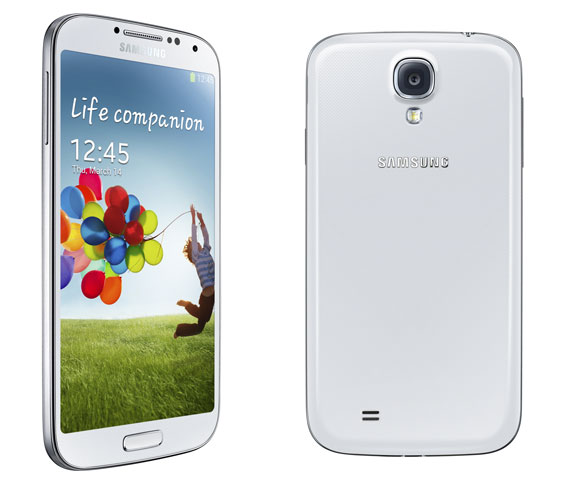
Samsung Galaxy S4 Review

Respons: 0 comments
Galaxy S 4 is finally here. Last year's version, the S III, remains the world's most popular Android phone, having sold over 40 million units.Samsung continues to focus on advanced mobile large. This Samsung Galaxy S4 has a five-inch screen with resolution Full HD . This is accompanied by an eight-core processor and a RAM memory of two gigabytes. In addition, its internal storage space may have different capacities: 16, 32 or 64, depending on user needs. Furthermore, to make matters worse, the memory cards that accept this equipment may be up to 64 GB .


On the other hand, also carries a camera of 13 megapixels with which, in addition to making good photographs, will also be capable of recording Full HD video for sharing later with family, friends or upload them directly to social networks. But beware, not all ends here. And this Samsung Galaxy S4 also features the latest version of the mobile platform Android 4.2.2 Jelly Bean on the user interface Samsung TouchWiz .


The Galaxy S4 packed with most important stuff:-

Air View: 
This feature lets you hover your finger a centimeter or two over the phone's display and view extra information or drop-down menus in apps. I found it the most useful in the email app, which lets you hover over a message in your inbox and get a quick preview of what it says. But it doesn't work with most apps, only a few that are made by Samsung and the specially designed Flipboard app. And it's still not as instant as actually touching the screen. There's a noticeable delay from the time you hover over the screen and when the action actually appears.

Air Gesture: 
When you switch on Air Gesture, you can scroll through photos in your gallery, browse websites, or answer incoming calls by waving your hand over the screen. Air Gesture was one of the most talked about features when the Galaxy S4 was first introduced, but it also happens to be one of the most impractical. I could only think of one scenario where waving your hand over the screen is better than actually touching it, and it's the example Samsung gave me –– Air Gesture is great if you're in the car and you need to answer the phone without looking.

Smart Stay: 
Smart Stay uses the Galaxy S4's front-facing camera to detect when you're looking at it and prevents the screen from going dark. Out of all the extras in the Galaxy S4, this is by the most useful. It solves a real problem with smartphones and tablets (How many times has your phone's screen gone dark while you were in the middle of reading an article?) and it's a feature you should always keep switched on.

Smart Scrolling: 
You've probably heard that the Galaxy S4 has a special eye-tracking technology used for scrolling. That's not entirely accurate. Like with Smart Stay, Smart Scrolling can detect when you're looking at the phone. You then tilt the phone forward or backward to scroll through pages. But smart scrolling didn't always work well for me, and like Air Gesture, I found it easier just to touch the screen to navigate the old-fashioned way. There's no real advantage to tilting your phone to scroll.

Camera: 
The camera software is really impressive, packed with a bunch of clever shooting modes that are easy to navigate to. (A lot of smartphone cameras tend to bury their extra modes.) Camera mode is called Eraser, which can automatically detect people moving in the background and remove them to create a nearly perfect image.

Conclusion
There has been a ton of hype and build-up to this device, and ultimately, it left us feeling cold. The S 4 feels uninspired. There are small spec bumps from the previous generation and there's a ton of software which will largely sit unused. There's just no wow-factor here.

I had the HTC One with me during my hands on time, and the difference is like night and day. For starters, the One is noticeably faster in every context. When flicking between screens, opening apps, and taking photos there was clear lag on the Galaxy S IV, whereas everything was almost instantaneous on the One. To be fair, this wasn't the final production version of the S IV, and who knows which processor was in the model I had. There's a chance it'll be faster at launch.

But even purely from a design perspective, the One absolutely crushes the S IV. When you pick up the One, you feel like you're holding something amazing, both in the build and the screen. When you pick up the S IV, you feel like you're holding an S III with a few extra bells and whistles.


Why Do You Need camera-phones with a Xenon flash ?

Respons: 2 comments

Many consumers are turned down by the lack of xenon flash in most smartphones. Camera phones usually utilize LED lights for taking images in dark environments but this mechanism is not as effective as a flash of light from a Xenon module. Although there are several models with Xenon flash on the market, such as the Nokia N8 and Sony Ericsson Satio, most of the smartphone lineup only utilizes LED flash technology.
Although LED flashes may be more efficient and do not require a recharging time, people still prefer to use Xenon flashes due to the usually better results it produces. Thus ditching a digital camera for a smartphone may be a viable solution for some individuals; but on the whole people prefer using dedicated cameras for photography.

There are several different reasons for this. Here we will go through some of the main reasons.

1. Picture quality suffers from insufficient light
Picture quality assessment is generally subjective. The following pictures were taken with
Xenon and LED flash in mobile phones equipped with a 5 Megapixel fixed focus CMOS camera
sensors.


Both images above were taken at 1m and 1.5m with low ambient light. The images on the left
were taken with Xenon light and those on the right were taken with an LED (drive at 500mA,
200ms). At 1m, in the picture taken with Xenon flash, the object and the background are
correctly exposed with sharp and rich color reproduction. In the picture taken with the LED, the
picture is generally still acceptable but with lower intensity visible and color reproduction is
poorer. 

At 1.5 m, the picture taken with Xenon flash still provides excellent illumination while the photo
with LED flash is visibly darker and with much detail lost as a result.
One key characteristic of light behavior is that as distance increases, the illumination drops not
linearly but rather at a rate proportional to the distance squared. This effect can be seen in the
way brightness deteriorates at distances greater than 1 m in the pictures above.

The pictures above demonstrate that the image can barely be discerned in pictures taken with
LED flash at distances greater than 1.5 m. On the other hand, pictures are rarely taken at
distances of 1 m or less because the viewing angle is too narrow to capture sufficient content.
This leaves only a quite small range of distances where LED flash is capable of taking acceptable
pictures. On the other hand, the pictures above show that Xenon offers much more light,
enough usually to extend the range in which the camera can take acceptable pictures to 3m or
more. 

2. Freezing motion
The short pulse (less than 200usec) of Xenon flash enable freezing of motion during picture
taking, thus deliver sharp picture of moving object.

3. Color Temperature
Xenon flash light provides consistent color temperature lighting that is closest to sunlight, thus perfect for photographic image quality. 

4. Fill flash
Xenon flash provides excellent solution for daylight fill flash when shooting outdoor portrait. It illuminates the
dark area of the subject caused by backlight from sun and strike an excellent balance between the brightness
of the subject and background.

5. Red eye reduction
Red eye effect on photograph can be reduced with preflash features of Xenon flash. This is made simple  by the extremely ease of manipulating the pulse pattern of the Xenon flash. A pre-flash can also be used for focusing as well as determining the correct amount of light required for a photography setting by the camera. This eliminates the auto focus LED that traditionally performed this function, particularly for the low-end or entry level camera devices.

6. Wider angle of illumination 
As wide angle (less than 28 mm) camera is getting more popular, it is a requirement that the light distribution of the flash unit must cover the wide angle with even brightness. Wide angle optical reflector solution is required to distribute light evenly throughout wider angle of illumination to match the wider angle of view from camera. Xenon flash natural linear configuration accompanied with proprietary optical reflector and lens design can provide the solutions.


7. Night Photograph
Many amateur photographers find night-time photography a great challenge. To overcome the challenges in exposure and focus, Xenon flash with its preflash and fill flash feature is able to help in the autofocus and also illuminate areas of deep shadow in images, thus provides perfect solution for night-time photography.

Conclusion
In just a few short years, camera mobile phones have gone from curiosity to mainstream imaging platform. The future of mobile still imaging will get better and converging into multiple-use handset. Most lower and mid-range flash-enabled camera mobile phones have used LEDs with low resolution CMOS sensors. But the move to 8 megapixel sensors and beyond is reducing sensitivity to the point that LEDs and  other light sources can no longer deliver enough light. Xenon flash technology has filled the gap by providing hundreds the light output, more even light distribution, much longer range, much shorter duration, color temperatures
matching natural sunlight, and much sharper image capture to compete with the DSC market. The result is that Xenon flash has become the technology of choice for the new generation of multi mega pixel camera mobile phones.
Related Posts Plugin for WordPress, Blogger...

Copyright © FMS Online

Sponsored By: GratisDesigned By: Habib Blog